Most forest owners are committed to sustainably managing their forestland, which often leads to the question: What does ‘certifying’ a forest mean? Forest certification sounds straightforward, but its standards and processes are evolving. In this article, we explain the key elements of forest certification and why it matters for South Carolina (SC) forest owners. First, we introduce the concept of forest certification and its importance. Next, we compare the sets of criteria used by certification bodies to highlight their potential conservation benefits. Third, we present a figure to illustrate the requirements of each certifying body and to address some logistical considerations. Finally, we highlight how forest owners could benefit from certifying their land and present the perspectives of SC forest owners regarding their hesitations to certify their land.
Effective forest management is essential for maintaining ecological balance and enhancing the livelihoods of local communities.1 Private forest owners are a crucial group of stakeholders in these efforts, as their management decisions significantly impact forest health, biodiversity, and ecosystem services provision.2 In addition to timber production, private forestlands offer habitat for wildlife and provide places for recreation and hunting. In the United States, the Southern region is the most forested and has the most forests in private ownership.3 Moreover, across the country, nearly 60% of forests are owned by private landowners.4,5 However, only a few private landowners have participated in forest certification.6
What Is Forest Certification and Why Is It Important?
Forest certification is a process that ensures forest management practices and the supply of forest products align with certain sustainability standards. It is a voluntary, market-based process that promotes sustainable forest management according to established standards.9 These standards usually include requirements for comprehensive management plans, biodiversity conservation, responsible harvesting practices, adherence to social and economic values, and consistent monitoring, all verified by an independent certification body.7,8 Through this process, certification promotes sustainable forest management, fosters consumer confidence, and enhances competitive advantage in the marketplace.10,11
The primary goal of forest certification is to establish a system through which companies and forest owners can demonstrate their commitment to responsible forest management while adhering to global standards for environmental, social, and economic best practices. These practices are set by international certification organizations such as the Programme for the Endorsement of Forest Certification (PEFC) and Forest Stewardship Council (FSC).9 PEFC serves as an umbrella organization, endorsing national forest certification systems (i.e., Sustainable Forestry Initiative (SFI), American Tree Farm System (ATFS)) that are created with input from various stakeholders and tailored to local needs. On the other hand, FSC is an international, non-governmental organization that develops national standards for each country such as the FSC U.S. National Forest Stewardship Standard.7
Forest certification was introduced at the 1992 United Nations Conference on Environment and Development, also known as the Earth Summit in Rio De Janeiro, as a response to increasing concerns about deforestation and unsustainable forestry practices.10,14 It was initiated by non-governmental organizations (NGO) (e.g., World Wide Fund for Nature, Greenpeace, and Rainforest Alliance) during the parallel NGO Rio meetings that recognized the need for improved forest stewardship.15 In 2023, approximately 1.1 billion acres of the world’s forests were certified under various certification programs.16,17 Notably, over 36.3 million acres of forests in the Southern United States are certified, representing 19% of the region’s total forest area.18 This reflects a growing recognition of the importance of sustainable forestry in this region.
What Are the Different Certification Programs and their Core Standards?
Forest certification encompasses several components directly or indirectly applicable to forest lands.19 In the Southern United States, the three (3) central forestry certification systems include the Sustainable Forestry Initiative (SFI), the Forest Stewardship Council (FSC), and the American Tree Farm System (ATFS). Among these three, SFI is the most widely adopted certification system in the U.S.20 Other certification programs are the Green Tag and the Forest Stewardship Program, which serve as recognition initiatives that incorporate certain certification program features. Relevant details regarding each certification system are as follows:
Sustainable Forestry Initiative (SFI)
SFI is a North American certification scheme developed to protect United States and Canadian forests and to ensure that forest product industries practice sustainable forestry.21 The SFI Forest Management Standard encompases13 principles, which include protecting water quality, biodiversity, wildlife habitats, species at risk, and Forests with Exceptional Conservation Value, among others (see Appendix A and B). As the world’s most extensive single forest management certification standard and endorsed by PEFC, SFI’s influence goes beyond standards. It also engages in collaborative efforts related to forest conservation, research, and community initiatives. SFI is committed to promoting healthy, productive forests, and to mitigate the impacts of climate change. Notably, SFI is the only forest management certification standard that requires its certified organizations to support forest and conservation research, producing valuable findings that benefit the forest and conservation sectors.19,22
Furthermore, SFI in collaboration with the American Forest Foundation (AFF) have developed the SFI Small Lands Group Certification Module designed for small-scale forest owners managing up to 20,000 acres (8,100 hectares). Under this module, it allows forest owners to participate in a group certification, reducing their administrative burden and shared costs of audits and documentation. The module is based on the requirements of the 2022 SFI Fiber Sourcing Standard and AFF forest management standards that promote sustainable forestry practices and long-term stewardship planning. By participating, forest owners gain market access for certified wood, while also benefiting from the credibility and recognition associated with SFI and PEFC certification. To use the SFI label, group managers and members must undergo third-party audits by an accredited certification body.23
Forest Stewardship Council (FSC)
FSC aims to ensure that forests are managed to preserve biological diversity, support forest workers and owners, and sustain the livelihoods of local communities and indigenous peoples. Moreover, FSC certification follows strict environmental, social, and economic standards and principles that guide responsible forest management worldwide. These standards include ten core principles that any forest operation must meet to receive certification (see Appendix A). For each principle, specific criteria provide practical guidelines for evaluating compliance.7,9 The principles are globally applicable, relevant to various forest ecosystems, and adapt to diverse cultural, political, and legal contexts. For example, the FSC US National Forest Stewardship Standard adapts global FSC principles, criteria, and International Generic Indicators (IGIs). This adaptation ensures that the standards are relevant and practical for the US while maintaining the integrity of the broader FSC system.25
To support private forest owners in the United States, FSC created the FSC-U.S. Family Forests program in response to small, non-industrial private landowners’ challenges in getting FSC certification. Landowners with less than 1,000 hectares or 2,470 acres of forest land and low-intensity managed forests (less than 20 percent of the average annual growth is harvested) are eligible for this program.26 Under this FSC-US Family Forests program, private forest owners work together with corporations and non-profit conservation groups such as GreenLink Forest Products and the Center for Forest Wood Certification to craft management plans compatible with the FSC standards. Moreover, these groups also provide low-cost group certification, education, and technical assistance for forest owners.26–28
American Tree Farm System (ATFS)
ATFS is the oldest and largest sustainable woodland program in the United States. It is instituted by the American Forest Foundation (AFF), targeting small forest owners with properties ranging from 10 to 10,000 acres. Currently, the program supports a network of 74,000 family forest owners who sustainably manage 19 million acres of forestland.30 ATFS is a community of landowners and forestry professionals promoting responsible forest management. ATFS-certified family forests adhere to eight (8) sustainability standards, which include water quality, wildlife habitat, wood production, and recreation (Appendix B). This strong network of woodland owners shares core values of hard work, community responsibility, and a commitment to preserving America’s forest legacy.30,31
One of the critical strengths of ATFS is its international endorsement by the Programme for the Endorsement of Forest Certification (PEFC). This endorsement enables forest products mills and manufacturers to promote sustainable forest management associated with a vast network of small family-owned forests in the United States. The American Forest Foundation (AFF) oversees ATFS and collaborates with Congress to ensure policies and programs support sustainable management for family and private landowners.30,32 Additionally, ATFS offers three certification options: State Tree Farm Committee Programs, Independently Managed Group programs, and Individual third-party certificates.
Core Standards of the Three Certification Bodies
To further understand the principles of the three central certification programs, we created a diagram to illustrate the common principles among these systems (Figure 1). All the principles for each program are listed and assigned a criterion to categorize these principles (see Appendix B). Common principles include: ecological integrity, legal compliance, protection of special sites, and sustainable forestry. However, there are certain principles which are unique to specific programs. For instance, SFI specifically emphasizes research and extension activities, outreach and responsible fiber-sourcing, while the aesthetic and recreation principle is common for both SFI and ATFS.

Figure 1. Shared principles of the three certification systems.
At the core of their principles, the three (3) central certification systems ensure that conservation benefits are demonstrated through the adoption of sustainable forestry practices that promote ecological integrity of forest lands. For instance, FSC requires implementation of practices that maintain forest lands’ ecosystem services and minimize any negative environmental impacts. SFI also recommends practices that improve forest productivity and health and protect water resources and biological diversity. Lastly, ATFS promotes practices that ensure air, water and soil protection, and enhances fish, wildlife, biodiversity, and forest health. Through the assessment of forest management plans and field verifications, the three certification systems ensure compliance and delivery of conservation benefits.
Appendix A also presents the key components of the three (3) central certification programs (FSC, SFI, and ATFS). These components include the mission, vision, processing instructions, and the cost and length of certification.
What Are the Requirements and How Is It Processed?
The certification process differs between systems, but all participants are required to outline their current management plan to address environmental, social, and economic impacts. Figure 2 shows that to get certified, the forest owner, with the help of a consulting forester, prepares their forest management plan and other documents in accordance with forest standard requirements. If the forest owner chooses to get SFI certified, they must first submit an application to SFI Incorporated. This is followed by contacting a certification body of choice (for either SFI or FSC) and submitting management plans and other required documents. In the case of ATFS, the landowner contacts the state Tree Farm Program and follows up with a state Tree Farm Inspector. This is followed by an inspection of an audit team from a certification body or ATFS Inspector. If the management plan meets the standard requirements, the forest is recommended for certification. If not, corrective action requests are provided, and another inspection is scheduled. After certification, periodic audits or inspections ensure continued compliance, with each program defining specific requirements.7,22,33
Forest owners interested in certification should review the available certification systems’ principles, requirements, and costs to find the best fit for their land. After choosing the most appropriate system, they should contact the relevant forest certification organization or certification body. Forest owners must select a certification system that aligns with their short- and long-term management goals and objectives.

Figure 2. Certification flowchart.
Although not required, a forest owner could hire a consulting forester to assist in preparation of application documents and management plans. In cases where the landowner is not yet prepared for auditing, the consulting forester or forest certification organization may recommend steps on how to improve their operation, management plan, and documentation.34,35 Once the auditing process is concluded and any non-compliance issues are resolved, the certification body will issue the certificate to the forest owner. According to SCS Global Services29, an independent third-party certification body, the whole certification process can take six to eight weeks. The duration varies with the complexity and size of the forest operation, with most of the time spent on audit preparation.
Certification fees vary by forest owner; typically, the cost per acre is lower for larger forest ownerships or group certifications. Forest certification costs can be incurred directly through fees for assessments and audits, and indirectly through adjustments to management practices such as record-keeping, staff training and facility improvements. Among the three certification systems, FSC has higher costs for individual certification, hence most FSC Family Forest owners opt for group certification to share the costs. The FSC does not control the fees charged by certification bodies for forest certification. FSC certification costs vary based on factors such as the size of the forest management operation, its location, and the type of forestry operation involved.26,29 Likewise, SFI certification costs can vary based on the scope of operations of the forest owner and depending on which accredited third-party certification body or auditor (e.g., Scientific Certification Systems (SCS) Global Services, National Sanitation Foundation (NSF) International) is contracted. In addition, SFI-certified forest owners pay an annual fee to SFI Incorporated, which helps fund conservation projects and outreach programs.24 SFI also focuses on corporate ownership and has direct costs. Currently, individual American Tree Farm System (ATFS) certifications have no direct costs and state program costs may vary, though this may change in the future.33–35
How Can Forest Owners Benefit from Certifying their Land?
In addition to conservation benefits, forest certification was developed to provide a market advantage to forest owners who practice sustainable forestry practices.9 Its benefits include market access for certified forest products and improved public image.36 Having a certification assures consumers that the wood products they buy originated from responsibly managed forests13 , helping certified forest owners access markets for sustainably-sourced forest products. 12 However, Brown and Zhang37 found that forest certification has a minimal impact on stumpage prices in the Southern United States.
Although forest certification does not guarantee higher stumpage prices, it is crucial for market access in some industries. For instance, our interview with one pulp and paper mill in South Carolina revealed that they purchase only certified wood to meet their clients’ requirements. Although they do not pay a higher premium for certified wood, they will not purchase anything that has no certification (Personal Communication, 2024). In addition, Garcia et al.38 emphasized that the economic benefits of forest certification are more associated with improved administration rather than increased in wood prices. These include crafting better management plans, monitoring, efficient communication and handling conflict management with stakeholders.39
Being certified also offers other social benefits such as access to training and essential resources. Newsom and Hewitt39 also noted that forest certification resulted in better roads and skid trails, along with improved worker safety. Auld et al.10 added that these certification schemes have become key and innovative mechanisms for standard setting and governance in the environmental sector. Forest owners become part of a community of landowners who share the common goal of improving their practices and the environmental benefits of their land.
What Holds Forest Owners from Certifying their Land?
Although certification offers several potential benefits for forest owners, interest and participation remain relatively low. To provide a better understanding of landowners’ perception towards forest certification, we conducted a survey to assess the awareness and opinions of private forest owners in South Carolina. Following the Tailored Design Method40, we mailed a survey to 3000 randomly selected SC forest owners between April and December 2024, and we received 388 complete responses. Of the 388 forest owners who participated in the survey, 17.93 percent (n=69) have forest certification. The majority of those who certified their land believed that getting certified was beneficial for maintaining a good reputation in the forestry sector, as well as achieving their personal sustainability goals. However, they also acknowledge the drawbacks of forest certification, such as the additional burden of compliance and lack of price premiums.
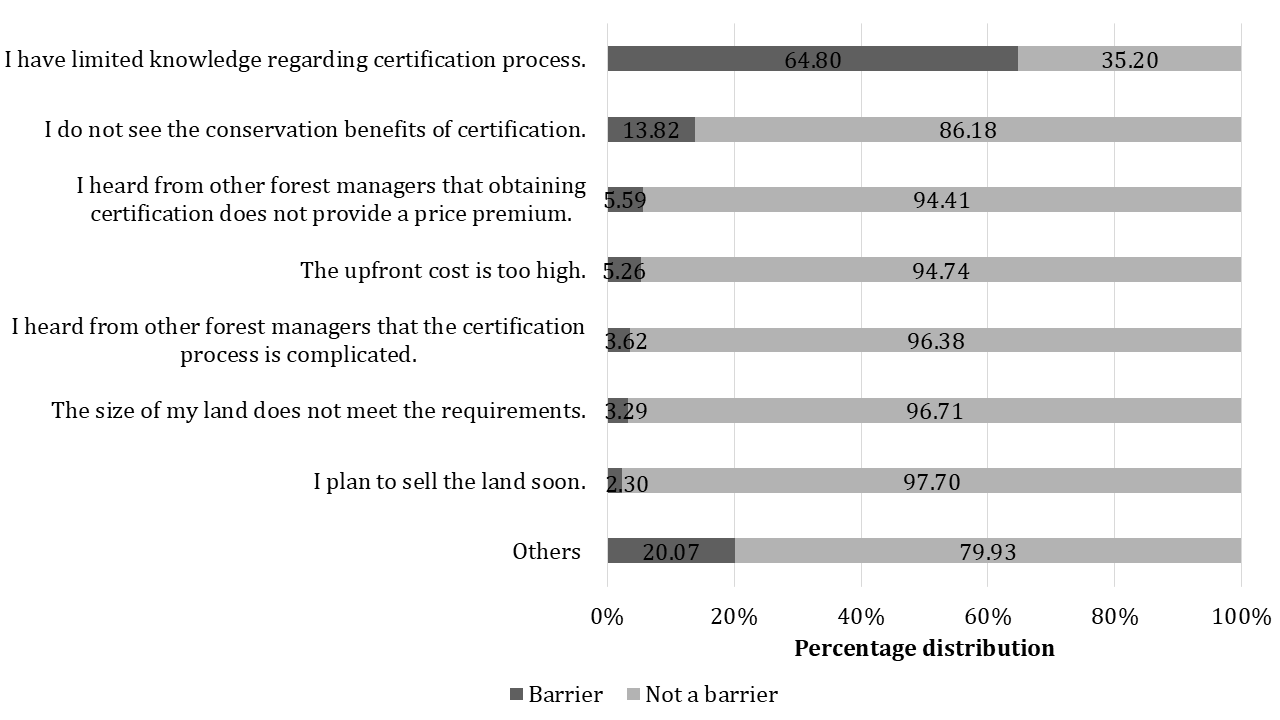
Figure 3. Forest owners’ barriers for certifying their land (n=319).
Additionally, more than 80 percent (n=319) of the forest owners who participated in our survey have no certification. We asked for reasons that hold them back from certifying their land (Figure 3). The main barrier was limited knowledge about forest certification. This suggests that many forest owners still lack sufficient knowledge about certification processes and requirements. Other barriers were the extra burden it places on them, high upfront cost, and a lack of perceived conservation benefits (Figure 3).
Conclusion
Forest certification is a tool that promotes sustainable practices, enhances market access for forest products, and encourages the conservation of ecosystem services. Despite the growing interest in forest certification, many forest owners still need guidance on navigating the certification process. In this paper, we outlined the three major certification bodies in the Southern United States (i.e., FSC, SFI, ATFS), their core standards, and their requirements. Although they differ in standards, they share similar key principles such as promoting sustainable forestry, ecological integrity, legal compliance, and protection of special sites.
The steps required for certification are consistent across these three systems. Interested forest owners, with the assistance of a consulting forester, would need to prepare a comprehensive forest management plan that aligns with the standards and objectives promoted by their preferred certification body. Once the required documents are submitted, a third-party auditor will conduct a field inspection and either recommend the land for certification or provide suggestions to help meet the standards. Forest owners could minimize the certification costs by applying together through the group certification programs available under SFI, FSC, or ATFS.
Based on the results of our survey, most South Carolina forest owners have not certified their forest land, citing reasons such as the lack of knowledge regarding the certification systems and their corresponding process and requirements. This highlights the importance of increasing outreach and extension efforts, such as workshops, lectures, and training programs to enhance awareness among South Carolina forest owners about forest certification and its importance.
References Cited
- Wang, C., Zhang, F., & Liu, W. (2024). The ecological management and sustainable development of forests. Forests, 15(5), 871. https://doi.org/10.3390/f15050871
- Food and Agriculture Organization. (2020). Global forest resource assessment 2020. https://www.fao.org/interactive/forest-resources-assessment/2020/en/
- U.S. Department of Agriculture Forest Service. (2021). U.S. forest ownership and management: Background and issues for Congress. https://sgp.fas.org/crs/misc/R46976.pdf
- U.S. Department of Agriculture Forest Service. (2023). National Woodland Owner Survey (NWOS). https://research.fs.usda.gov/programs/nwos
- National Association of State Foresters. (2022). 2020 state foresters by the numbers. https://www.stateforesters.org/wp-content/uploads/2022/01/2020-State-Foresters-by-the-Numbers-01272022.pdf
- Fernholz, K., Bowyer, J., McFarland, A., & Pepke, E. (2021). Forest certification update 2021: The pace of change.
- Forest Stewardship Council. (2024, May 3). FSC standards. https://fsc.org/en/fsc-standards
- Programme for the Endorsement of Forest Certification. (2024). Standards and guides. https://pefc.org/standards-implementation/standards-and-guides
- Cashore, B., Gale, F., Meidinger, E., & Newsom, D. (2006). Confronting sustainability: Forest certification in developing and transitioning countries.
- Auld, G., Gulbrandsen, L. H., & McDermott, C. L. (2008). Certification schemes and the impacts on forests and forestry. Annual Review of Environment and Resources, 33(1), 187–211. https://doi.org/10.1146/annurev.environ.33.013007.103754
- Meidinger, E. (Ed.). (2003). Social and political dimensions of forest certification. Kessel.
- Corticeiro, S., et al. (2024). Forest certification and economic insights: A European perspective. Frontiers in Forests and Global Change, 7. https://doi.org/10.3389/ffgc.2024.1464837
- Sustainable Forestry Initiative. (2015). 2015–2019 standards and rules. https://forests.org/wp-content/uploads/2015_2019StandardsandRules_web_Feb_2017.pdf
- Wolff, S., & Schweinle, J. (2022). Effectiveness and economic viability of forest certification: A systematic review. Forests, 13(5), 798. https://doi.org/10.3390/f13050798
- Gulbrandsen, L. H. (2004). Overlapping public and private governance: Can forest certification fill the gaps in the global forest regime? Global Environmental Politics, 4(2), 75–99. https://doi.org/10.1162/152638004323074200
- Forest Stewardship Council. (2024). What is FSC? https://anz.fsc.org/what-is-fsc
- Programme for the Endorsement of Forest Certification. (2024). Facts and figures. https://pefc.org/discover-pefc/facts-and-figures
- Southern Group of State Foresters. (2021). Forest certification. https://southernforests.org/resources/publications/
- Cubbage, F., Moore, S., & Henderson, T. (2009). Costs and benefits of forest certification in the Americas.
- American Forest Management. (2024). Forest certification support. https://www.americanforestmanagement.com/services/forest-certification
- Sustainable Forestry Initiative. (2024). Who we are. https://forests.org/who-we-are/
- Sustainable Forestry Initiative. (2022). SFI 2022 standards. https://forests.org/sfi-2022-standards/
- SFI Small Land Groups. (2022). Small land groups module. https://forests.org/sfi-standard-small-land-groups/
- Sustainable Forestry Initiative. (2024). Get certified & third party audits. https://forests.org/third-party-audits/
- Forest Stewardship Council. (2022). U.S. national forest stewardship standards. https://us.fsc.org/preview.final-draft-of-the-us-national-forest-stewardship-standard.a-884.pdf
- Forest Stewardship Council®-United States. (2024). Family forests. https://us.fsc.org/en-us/certification/forest-management-certification/family-forests
- GreenLink Forest Products. (2024). Group certification and services. http://www.greenlinkstewards.com/
- Center for Forest and Wood Certification. (2024). Home. https://cfwc.ca.uky.edu/
- SCS Global Services. (2022, May 4). FSC® forest certification. https://www.scsglobalservices.com/services/fsc-forest-certification
- American Tree Farm System. (2024). About American Tree Farm System. https://www.treefarmsystem.org/about-tree-farm-system
- Butler, B. J., et al. (2022). An assessment of the sustainability of family forests in the U.S.A. Forest Policy and Economics, 142, 102783. https://doi.org/10.1016/j.forpol.2022.102783
- Programme for the Endorsement of Forest Certification. (2024). Our PEFC members. https://www.pefc.org/discover-pefc/our-pefc-members/national-members/american-tree-farm-system-atfs
- American Tree Farm System. (2024). ATFS 2021 standards of sustainability. https://www.treefarmsystem.org/view-standards
- Forest Stewardship Council. (2024). Become certified. https://us.fsc.org/en-us/certification/become-certified
- Sustainable Forestry Initiative. (2024). How to certify. https://forests.org/how-to-certify/
- Chen, J., & Innes, J. L. (2013). The implications of new forest tenure reforms and forestry property markets for sustainable forest management and forest certification in China. Journal of Environmental Management, 129, 206–215. https://doi.org/10.1016/j.jenvman.2013.07.007
- Brown, R., & Zhang, D. (2005). The Sustainable Forestry Initiative’s impact on stumpage markets in the U.S. South. Canadian Journal of Forest Research, 35(8), 2056–2064. https://doi.org/10.1139/x05-135
- Garcia, E., et al. (2024). Socioeconomic and environmental impact of forest certification in ejidos and communities of the state of Durango, Mexico. International Forestry Review, 25(4), 399–409. https://doi.org/10.1505/146554823838028238
- Newsom, D., & Hewitt, D. (2005). The global impacts of SmartWood certification. https://citeseerx.ist.psu.edu/document?repid=rep1&type=pdf&doi=a5579b11eaec72c6f51b28b40beac9709a0ea81a
- Dillman, D. A. (2007). Mail and internet surveys: The tailored design method: 2007 with new internet, visual and mixed-mode guide (2nd ed.). Wiley.
Additional Resources
For more detailed information on the certification process for each system, please refer to their respective websites (Forest Stewardship Council (FSC): www.fsc.org; Sustainable Forestry Initiative (SFI): www.sfiprogram.org and American Tree Farm System (ATFS): www.treefarmsystem.org).
Acknowledgments
This research is supported by funding provided through Forest Futures and Climate-Smart Grown in SC, a USDA-NRCS Partnerships for Climate-Smart Commodities project. Any opinions, findings, conclusions, or recommendations expressed here are those of the author(s) and do not necessarily reflect the views of the U.S. Department of Agriculture. In addition, any reference to specific brands or types of products or services does not constitute or imply an endorsement by the U.S. Department of Agriculture for those products or services. USDA is an equal opportunity provider, employer, and lender.
We appreciate the pulp and paper mill employees for their time and willingness to share their insights, which contributed to this research.
Appendices
Appendix A. Details About Selected Certification Systems.
| Certification system | Date established | Mission and Vision | Principles | How to apply | Cost and length of certification |
| Forest Stewardship Council (FSC)
|
1994 | Mission:
Promote environmentally sound, socially beneficial and economically prosperous management of the world’s forests. Vision: meet the current needs for forest products without compromising the health of the world’s forests for future generations. |
10 principles | To get FSC Forest Management certification, a forest owner or manager works with an approved certification group or organization. (https://us.fsc.org/en-us/certification/forest-management-certification)
For the list of third parties: (https://us.fsc.org/en-us/certification/certifying-bodies-in-the-us) |
1) The certification bodies provide the price quote. Usually for forestlands less than 2,470 acres (minimum range $3,000-$5,000)
2) Group certification reduces costs by sharing expenses among multiple landowners. Length of certification: 5 years |
| Sustainable Forestry Initiative (SFI)
https://forests.org/ |
1995 | Mission:
Advance sustainability through forest-focused collaboration. Vision: A world that values and benefits from sustainably managed forests |
13 principles | All SFI standards require independent audits by qualified, accredited organizations. These organizations must be approved by recognized accreditation bodies like the ANSI-ASQ National Accreditation Board (ANAB) in the U.S. or the Standards Council of Canada (SCC). (https://forests.org/how-to-certify/ or https://forests.org/third-party-audits/). | The certification bodies provide the price quote. Usually, direct costs range from $0.96 to 9.56 per hectare yearly (Cubbage et al, 2009).
Length of certification: 5 years |
| American Tree Farm System (ATFS)
https://www.treefarmsystem.org/ |
1941 | Mission:
Promote the growth of renewable forest resources on private lands while protecting the environment and increasing public understanding of the benefits of forestry Vision: Build a national movement of landowners who actively care for their woods, protect clean water and wildlife habitat, and provide sustainable wood |
8 standards of sustainability | Check the steps in the ATFS website. (https://www.treefarmsystem.org/tree-farm-certification-steps). Request a property visit from an ATFS-certified forester by contacting your ATFS State Program (https://www.treefarmsystem.org/state-tree-farm-programs) |
1) Individual certification is free
2) State Tree Farm Committee Programs – fees vary by state 3) Group certification Administration fee: Administration fees will be based on the fee schedule below and be no less than $500.00 per group entity per year: Less than 250,000 acres: $0.02/ acre 250,000- 4999,999 acres: $0.03/ acre 500,000-999,999 acres: $0.04/acre 1 million acres or more: $0.05/acre Length of certification: 5 years |

Source: FSC8, SFI10 , ATFS29 and authors.
Appendix B. Principles of the three Certification systems
| Code | Principles | Certification |
| Legal compliance | Comply with all applicable laws | FSC |
| Workers well-being | Maintain or improve the social and economic well-being of workers; | FSC |
| Indigenous people’s rights | Uphold the rights of Indigenous Peoples | FSC |
| Local communities’ well-being | Maintain or improve the social and economic well-being of local communities; | FSC |
| Sustainable forestry | Manage their products and services in a way that maintains or improves their long-term economic viability, social benefits, and environmental benefits; | FSC |
| Ecological integrity | Maintain, conserve, and/or restore the ecosystem services and environmental values of managed forests; and also avoid, repair, or mitigate negative environmental impacts; | FSC |
| Forest management plan | Establish a management plan that outlines their economic, environmental, and social policies and objectives; | FSC |
| Continual improvement | Demonstrate progress toward meeting these objectives; | FSC |
| Protection of Special sites | Maintain or improve high conservation values; | FSC |
| Transparency | Ensure that all management activities comply with FSC principles and criteria. | FSC |
| Sustainable forestry | Sustainable Forestry | SFI |
| Ecological integrity | Forest Productivity and Health | SFI |
| Ecological integrity | Protection of Water Resources | SFI |
| Ecological integrity | Protection of Biological Diversity | SFI |
| Aesthetic and Recreation | Aesthetic and Recreation | SFI |
| Protection of Special sites | Protection of Special Sites | SFI |
| Legal compliance | Legal and regulatory compliance | SFI |
| Workers well-being | Legal and regulatory compliance | SFI |
| Research | Research | SFI |
| Training and outreach | Training and Education | SFI |
| Indigenous people’s rights | Community involvement and Social responsibility and respect for indigenous rights | SFI |
| Local communities’ well-being | Community involvement and Social responsibility and respect for indigenous rights | SFI |
| Transparency | Transparency | SFI |
| continual improvement | Continual Improvement | SFI |
| Responsible Fiber sourcing | Responsible Fiber sourcing | SFI |
| Sustainable forestry | Commitment to Practicing Sustainable forestry | ATFS |
| Legal compliance | Compliance with Laws | ATFS |
| Sustainable forestry | Reforestation and Afforestation | ATFS |
| Ecological integrity | Air, water and soil protection | ATFS |
| Ecological integrity | Fish, wildlife, biodiversity and forest health | ATFS |
| Aesthetic and Recreation | Forest aesthetics | ATFS |
| Protection of Special sites | Protect special sites | ATFS |
| Sustainable forestry | Forest Product Harvests and other activities | ATFS |
Source: FSC8, SFI10, ATFS29 and authors.