

This brief provides an example of project-based learning that was applied to the FOR 3410 – Wood Procurement Practices in the Forest Industry undergraduate course. After teaching this course for 4 years, it was determined that project-based learning aligned well with the learning outcomes and activities the students would encounter in their professional careers, resulting in better student engagement in the course and higher retention of the concepts.
Introduction
Using real-world examples and activities is at the core of project-based learning. With project-based learning, students are not tested on their ability to memorize information for an exam but rather must apply the knowledge they have gained in a course to a real-world project that they complete (Condliffe et al., 2017; Hall & Miro, 2016). Research has shown that project-based learning increases comprehension and long-term retention of information compared to more traditional exam-based learning (Gratchev, 2023). Today, project-based learning can be found in STEM courses at universities as well as in high school courses in many different countries across the globe (Craig & Marshall, 2019; Gratchev, 2023; Hanif et al., 2019). There is evidence suggesting that project-based learning has advantages for student learning, but it may require a different type of preparation for the instructor (Condliffe et al., 2017; Kokotsaki et al., 2016). Further, not all courses may be suitable for project-based learning. In some instances, students are required to memorize terms, species names, etc., and testing their knowledge with an exam may be the most appropriate way to assess their progress.
The FOR 3410 course on wood procurement focuses less on memorizing terminology and instead requires students to apply the knowledge they have learned to real-world scenarios. The course teaches the art and science of buying raw materials (trees, and tree parts) at an appropriate price, time, and quantity for a manufacturing facility. In forestry, multiple stakeholders play their own unique roles in growing and managing the forests we all know and see: the landowner grows the trees (Hiesl & Steele, 2023; Khanal & Straka, 2020), the logger harvests the trees and processes into logs (Hiesl & Steele, 2020), and the mill processes logs into final products (e.g. paper, lumber, panels). Most often, standing trees are sold either to a logger, a mill, or a third-party entity called a wood dealer. The sale of these trees can happen in many ways, including sealed timber bids (Hiesl, 2020). Sealed timber bids require a forester to assess the trees that are up for sale for quality and quantity. With that information, they calculate a total value for the trees. From that total value, the forester will then subtract the cost of harvesting the trees, transportation to a mill, and any other expenses that can be reasonably expected on that site. The remaining value is called “stumpage” and is the value of the above-ground portion of trees that a landowner may get for them.
Description of Teaching Activity
To assess students’ comprehension of buying and selling trees and logs, I use one comprehensive project-based assignment, the Timber Sale Project. The Timber Sale Project is completed individually and assigned after three weeks of lecture time, with a due date three weeks later. During the first three weeks of lecture time in the FOR 3410 course, students learn about the different procurement practices in the forest industry and work through multiple timber bid calculations with the instructor on the whiteboard and in Excel. During the next three weeks, students will continue to work on timber bid calculations during the lecture time using actual South Carolina timber bid sale announcements from the South Carolina Forestry Commission. These calculations take place in the classroom, but students mostly work in groups or individually while the instructor circulates the room to monitor and help individual students who struggle with the calculations. The class is relatively small, typically 20 to 30 students, and has a scheduled lecture time of 75 minutes. During these three weeks, students will also start working on the Timber Sale Project on their own time.
The Timber Sale Project that students complete is complex and consists of two parts: mill assignment and timber sales. A total of seven fictional mills, all with unique characteristics and raw material requirements, have been created and placed across the state. Each student is randomly assigned one of the seven mills and is instructed to be the procurement forester for that mill, responsible for providing the correct quality and quantity of raw materials. A total of 11 fictional timber sales across the state have been developed, all with unique characteristics of reported available volume, species, and quality. All students receive all the timber sales and are now instructed to assess each timber sale and provide a bid value if the sale is appropriate for their assigned mill. Based on their judgment, students have two choices: either calculate the timber bid and provide the bid values following the unique instructions for that timber sale or decide not to bid on that sale and provide a brief (2-3 sentences) justification for why they decided not to place a bid. The latter option is not a way to get out of all timber bid calculations but is designed to be used when an available timber sale, for example, is not providing a large amount of the desired raw material for the mill that the student represents. This reflects the nature of the forest industry, where procurement foresters receive multiple bid invitations, but only some are a viable option for their mill. Depending on the assigned mill, between 3 and 5 timber sales are typically a viable option for students to bid on.
Students are required to upload a PDF file with their bid values and justifications, as well as an Excel file showing all their calculations, to the learning management system (LMS) Canvas by the due date. Canvas is the current LMS used by Clemson University. To simulate an actual bid opening procedure, the instructor enters all submitted bid values from each student into an Excel file and then hosts a “bid opening” in the next class session. During the bid opening, all bid values will be shown on the screen, and we will select the winning bidder for each of the 11 timber sales. We also discuss the range of bid values, the need to pay attention to detail when responding to a bid and reinforce the power of the data and what it shows us about the current market situation. To introduce more complexity in the timber bid process and model current industry activities, some variables, such as mill-delivered prices or capacity restrictions, are changed randomly for a select number of students. While this does not change the procedure for the student, it will allow for a range of different timber bid values that can be discussed during the bid opening process. Independent of the bid opening, each student’s project submission is graded individually based on a rubric that was made available to students when the project was assigned (See supplemental material).
Discussion of Outcomes
Before utilizing this project-based assignment, students would sit in the classroom, listening to the instructor’s lectures and guest speakers. While students would still work through some actual timber bid sales, their involvement with these sales stopped when they left the classroom. With that, it was challenging to get students to apply what they had learned in a meaningful way that engaged them in critical thinking and decision-making processes.
Since introducing this project, students have become more active in class, and I have reduced the number of PowerPoint lectures and focused more on experiential learning activities. My personal assessment is that students better understand the concept and are more capable of working up a timber bid on their own. I also noticed that students are less anxious in class. Talking with some of my students, this is mainly because there is no exam that they must study for on this topic that could otherwise give them anxiety.
On the course evaluations, students also commented on the value of this project-based learning and examination approach. For example, students provided the following comments in the course evaluations: “I think all the projects help us understand the concepts more than an exam does which is important,” “I really think this class benefited me because the class is based around projects and real-world situations. I found it very useful working through the projects and also having professionals come into class and work through them with us,” “The hands-on nature of the course kept me engaged and focused throughout the course,” “What I like about the course is the practicality of the assignments. They all felt like things we could realistically be doing in a job one day.”
Having a project as part of the teaching approach does not mean the sacrifice of academic rigor. The rubric provided with this project assignment further demonstrates the academic rigor that is expected with this assignment to receive a good grade. Additionally, several industry professionals have commented on the extent of this project and told me that this is “a lot” to do for students. But they also all agree that this project is important and simulates realistic conditions. Students have also commented on the use of projects in this class, which is often summarized in “lots of work but learn a lot” comments.
Reflection of Outcomes
The FOR 3410 course project-based grading was designed based on my participation in the Faculty Institute workshop of the Clemson Thinks2 Faculty Development program during the summer of 2020. Clemson Thinks2 is a program within Clemson University with the goal of developing critical thinking pedagogical skills of faculty and critical thinking skills of students. During the Faculty Institute workshop, we read the book “Creating Wicked Students” by Hanstedt (2018). The author argues that students should be presented with “wicked problems” in the classroom to go beyond content knowledge, but to require students to apply their knowledge in thoughtful and meaningful ways. Wicked problems include any of today’s challenges in society, so using real-world examples for the Timber Sale Project and developing a project-based assignment was the next logical step following the reading of this book and the completion of the Faculty Institute workshop.
In addition to creating the Timber Sales Project, I changed my course to be more dependent on project work rather than exams. The syllabus for the FOR 3410 – Wood Procurement Practices in the Forest Industry course includes five projects and a final exam (Figure 1). While the grading weights of individual projects may change from year to year, the five projects determine 85% of the final course grade.
Since the introduction of mostly project-based assignments in the FOR 3410 – Wood Procurement Practices in the Forest Industry course, there has been a noticeable shift in the final course grades of students. Using project-based learning to assess students, the vast majority receive a final grade of “A”, with few students getting a “B” or “C” grade. Before using project-based assignments, the grade distribution was different and more heavily focused on “B” and “C” grades. Many factors likely play into the change in grade distribution, but using project-based assignments has positively influenced student learning outcomes. Zhang and Ma (2023) have used a meta-analysis of research papers on project-based learning and have shown that project-based learning contributes positively to students’ academic achievements.
Instructor observation is that students were less anxious with project-based assignments. Many students commented that they would rather work on a project than sit an exam, even if it means spending more time on it. Exam anxiety in university students is real and has been the focus of research since the 1950s, and manifests in many ways and across genders (Trifoni and Shahini, 2011). In addition, students felt like they learned something valuable for their careers that resembled a real-world application. I received many comments from graduates over the years that all highlighted that the projects in the course helped them in their careers. While there is no hard data for me to validate that, research studies across the globe have outlined the many benefits of project-based learning, with a summary found in Condliffe et al. (2017). I also believe that students invested more time learning the topic and completing the project than they would have for a traditional exam. Lastly, project-based learning led to a different student-teacher atmosphere in the classroom with more open discussions, questions, and hands-on activities to supplement the teaching. The projects also triggered some more informal talks with students, which ranged from more technical questions on completing the project to sincere questions about applying the material to their future jobs, to more critical questions about their experience with the topic during internships.
Transitioning to project-based learning was more work than expected and required significant time to develop the project materials. However, once the materials were developed, maintenance required relatively little time, other than some minor changes from year to year. As the industry changes, I also make changes to my project to reflect current industry trends. This also makes for a great discussion point with students to cover current challenges in the industry.
In summary, while it took time to develop the project materials, the benefits reaped far outweigh the effort. Based on my experience, I would not go back to traditional teaching methods, but instead continue to develop new and modified project activities.
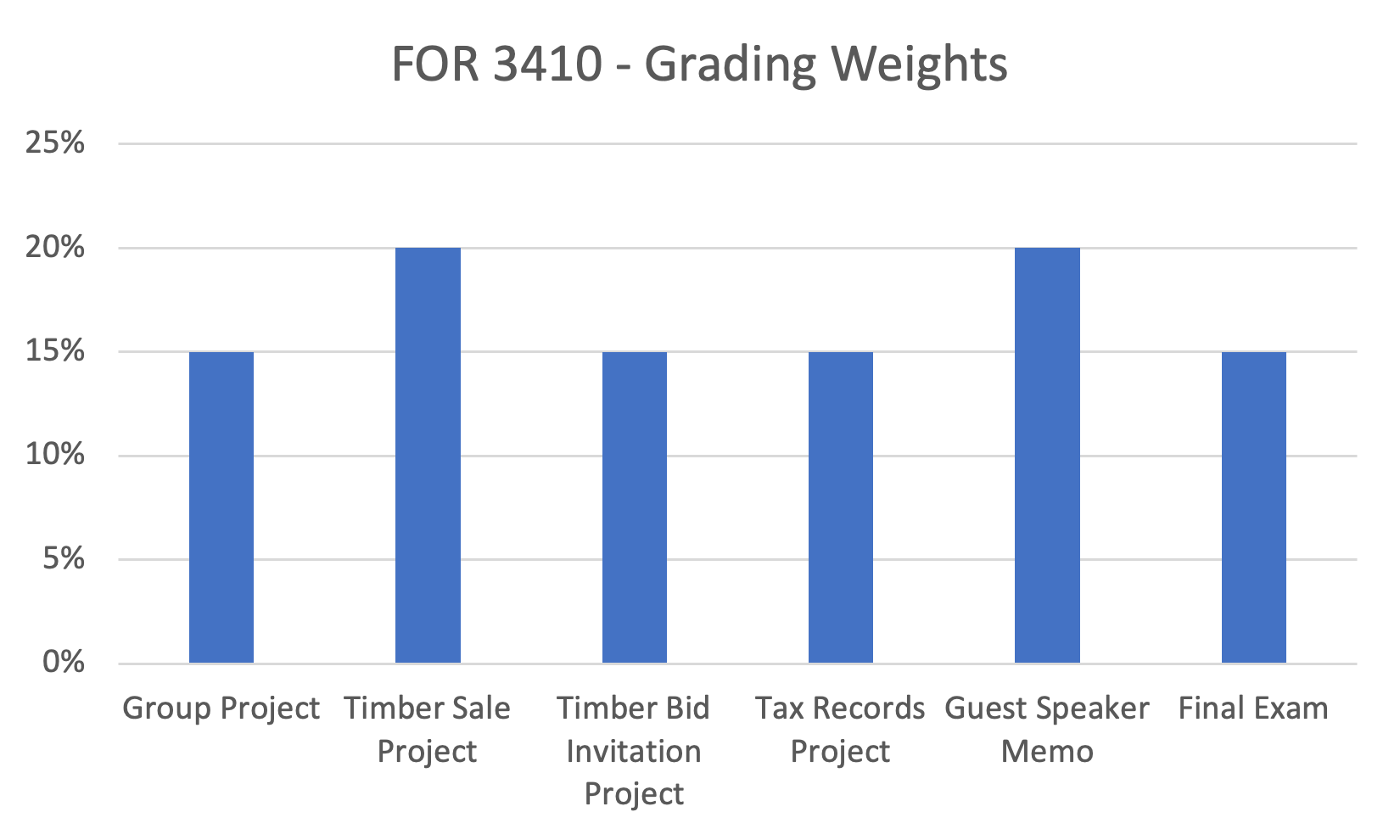
Figure 1. Grading weights for all projects in the FOR 3410 course.
Discussion of Potential for Adoption in Other Courses
Project-based learning and project-focused assignments can be implemented in many courses. It is important to have clear learning objectives for the course and then tailor the project to facilitate the learning process. Ideally, a project is closely related to the work students will do once they graduate. This may be easier in some fields of study, such as forestry, compared to other fields that have a broader range of employment opportunities for students. Nonetheless, a project should be as closely related to the real world to allow students to apply what they have learned in the course in a meaningful manner. For many students, working on a project that they know is similar to what they will need to do once they graduate is a good motivator.
It is also important to understand that projects can be staggered. Multiple smaller projects can be utilized during the semester to build a practical knowledge base for students. These smaller projects could also be a part of a larger final project, so that all assignments during the semester help to shape the final project work. Project-based learning can also be used in addition to or in combination with more traditional evaluation methods, such as exams and quizzes. This will depend on the topic of the course, the learning objectives, and the experience of the instructor, to decide what will achieve the learning outcomes for a course.
While there is some upfront work to design a project and the associated grading rubric, the payoff is immense. There is nothing more satisfying for an instructor than to see students excel in a project and apply what they have learned in a course.
References Cited
Condliffe, B., Quint, J., Visher, M. G., Bangser, M. R., Drohojowska, S., Saco, L., & Nelson, E. (2017). Project-based learning: A literature review. MDRC. https://www.mdrc.org/work/publications/project-based-learning
Craig, T. T., & Marshall, J. (2019). Effect of project-based learning on high school students’ state-mandated, standardized math and science exam performance. Journal of Research in Science Teaching, 56(10), 1461–1488. https://doi.org/10.1002/tea.21582
Gratchev, I. (2023). Replacing exams with project-based assessment: Analysis of students’ performance and experience. Education Sciences, 13(4), 408. https://doi.org/10.3390/educsci13040408
Hall, A., & Miro, D. (2016). A study of student engagement in project-based learning across multiple approaches to STEM education programs. School Science and Mathematics, 116(6), 310–319. https://doi.org/10.1111/ssm.12182
Hanif, S., Wijaya, A. F. C., & Winarno, N. (2019). Enhancing students’ creativity through STEM project-based learning. Journal of Science Learning, 2(2), 50–57. https://doi.org/10.17509/jsl.v2i2.13271
Hanstedt, P. (2018). Creating wicked students: Designing courses for a complex world (1st ed.). Stylus Publishing, LLC.
Hiesl, P. (2020). Sealed timber bids: What you need to know to sell your timber (Article LGP 1078). Land-Grant Press by Clemson Extension. http://lgpress.clemson.edu/publication/sealed-timber-bids-what-you-need-to-know-to-sell-your-timber/
Hiesl, P., & Steele, J. (2020). Timber harvesting equipment in South Carolina (Article LGP 1056). Land-Grant Press by Clemson Extension. https://lgpress.clemson.edu/publication/timber-harvesting-equipment-in-south-carolina/
Hiesl, P., & Steele, J. (2023). Managing pine trees with a thinning (Article LGP 1178). Land-Grant Press by Clemson Extension. https://lgpress.clemson.edu/publication/managing-pine-trees-with-a-thinning/
Khanal, P., & Straka, T. (2020). Fundamentals of forest resource management planning (Article LGP 1047). Land-Grant Press by Clemson Extension. http://lgpress.clemson.edu/publication/fundamentals-of-forest-resource-management-planning/
Kokotsaki, D., Menzies, V., & Wiggins, A. (2016). Project-based learning: A review of the literature. Improving Schools, 19(3), 267–277. https://doi.org/10.1177/1365480216659733
Trifoni, A., & Shahini, M. (2011). How does exam anxiety affect the performance of university students? Mediterranean Journal of Social Sciences, 2(2), 93–100.
Zhang, L., & Ma, Y. (2023). A study of the impact of project-based learning on student learning effects: A meta-analysis study. Frontiers in Psychology, 14, 1202728. https://doi.org/10.3389/fpsyg.2023.1202728