Collaborative learning across disciplines can be advantageous. A Creative Inquiry (CI) course paired Animal and Veterinary Sciences and Public Health Sciences students to compete in a Global Solution Competition. This CI challenged the student pairs to develop solutions toward the United Nations Sustainable Development Goals (SDGs) in a low-income nation. Course participants reported a deeper understanding of SDGs through collaborating with non-discipline peers, as reflected in survey and focus group findings.
Introduction
Higher education brings people with diverse backgrounds and unique skill sets together to learn and apply their knowledge every day. However, most peer interactions occur in class settings, which are often based on majors and unite students who already share similar interests or post-educational plans. Our team sought to explore whether introducing a collaborative experience combining students from different disciplines would produce a unique learning experience compared to traditional major courses.
An interdisciplinary course brings students from different disciplines together to work toward a common goal using their unique sets of knowledge and skills.1 Still, the practice is uncommon among university course catalogs. Previous research has suggested that joining students with different knowledge sets to solve challenges through teamwork promotes student partnership and increases problem-solving aptitude.2 Courses that grant students the freedom to work independently of strict rubrics encourage learners to research what they are passionate about. This type of student-directed learning enhances student engagement and motivation, and facilitates student ownership in diverse ways.3,4
One topic especially applicable to the interdisciplinary lens is the United Nations (UN) Sustainable Development Goals (SDGs). The UN SDGs are seventeen unique goals designed to incite peace and prosperity in every nation without regard for their income designation.5 Each of the seventeen goals focuses on one aspect of sustainable development, including ending poverty, climate justice, and increasing equality. The World Health Organization (WHO), an agency of the UN, is one of the many organizations working toward achieving these seventeen goals by 2030, emphasizing that no individual should be left behind.6 Currently, SDGs 4 (Quality Education) and 17 (Partnerships for the Goals) are more commonly addressed in higher education contexts due to their broader focus compared to other SDGs, meaning students do not necessarily need topic-specific background knowledge to solve problems related to SDGs 4 and 17.7 While it may not be plausible to introduce a course integrating all seventeen SDGs to solve a global challenge, a starting point might be uniting two distinct goals: Goal 2 (Zero Hunger) and Goal 3 (Good Health and Well-Being).
To gather students from different disciplines, a team utilized Clemon University’s Creative Inquiry (CI) course format (students study a targeted topic for varying course credits). This CI course allowed students to compete in a Global Solution Competition (GSC) during the Spring 2024 semester. This style of education and inquiry aligns with a key component of Clemson Elevate’s first pillar,8 Deliver the #1 Student Experience, which promotes Kolb’s Experiential Learning Cycle. Kolb’s theory views learning as a cyclic process composed of four stages:9
- concrete experience (feeling),
- reflective observation (watching),
- abstract conceptualization (thinking), and
- active experimentation (doing)
Kolb postulated that the acquisition of knowledge happens through the “transformation of an experience,” wherein learners are personally involved with the subject matter through an activity like problem-solving, then move on to think about what and why that experience happened, and conclude by putting the knowledge they’ve gained into practice by planning and solving a real-world problem.10
Thus, we aimed to create student teams that paired individuals across disciplines to address a global challenge by integrating their unique knowledge sets. Teams were composed of one Animal and Veterinary Sciences (AVS) student and one Public Health Science (PHS) student, each of whom studied SDG 2 and SDG 3 in their respective courses. The GSC goal was for student pairs to propose solutions to real-world problems that addressed both SDGs within a competitive presentation setting. The project aimed to determine whether the interdisciplinary, experiential problem-solving approach improved student learning and outcomes.
Description of Teaching Activity
Solving Global Development Challenges CI Formation
The foundation courses came from two colleges: Animal and Veterinary Sciences (AVS – AVS 4150: Contemporary Issues in AVS) and Public Health Sciences (PHS – HLTH 4700: Global Health).
- HLTH 4700 exposes students to the factors influencing global health and well-being, particularly in low and middle-income countries, with a focus on SDG 3. Throughout this course, students learn about the factors that contribute to the health of populations across varied income levels and the current strategies in place to help countries satisfy the targets within SDG 3. The signature assignment of HLTH 4700 utilizes a scaffold format in which students research health equity in a selected low-income country, explore current progress toward achieving SDG 3, and design an evidence-supported plan for improvement. The six-page paper deliverable highlights the student’s evaluation of the status of SDG 3 in their chosen country and proposes evidence-based strategies for accelerating progress toward attaining good health and well-being as described by SDG 3.
- AVS 4150, a capstone course, focuses on issues facing animal science and agriculture globally, particularly regarding SDG 2. Students learn about the cultural, economic, and environmental factors contributing to food security in relation to agriculture worldwide. The signature assignment, a semester-long research project, challenges student teams to select a low- or lower-middle-income target country to attempt to mitigate food insecurity by creating a strategic plan involving an animal production system. These proposals are presented to the instructor and the rest of the class as a twenty-five-minute multimedia presentation that includes background information, objectives, and the plan itself.
These two classes shared similarities in their course setup and objectives, and the course instructors each felt that they wanted to expand the current scope of their course into something more interdisciplinary that could be applied cross-colleges. To make this happen, the instructor of AVS 4150 sought advice from the Office of Teaching Effectiveness and Innovation (OTEI) at Clemson, where they were connected with the HLTH 4700 instructor based on the resemblances their separate courses held. The two instructors agreed they should look deeper into the issue of SDGs on a holistic scale rather than in solely their separate fields and recruited additional help from OTEI and one past student from each course to assist in developing a research question. For the first semester, the majority of the team’s work went toward looking into existing literature surrounding how the SDGs are taught at the university level and what further research could be done with the SDGs. To evaluate current students’ global perspective, a pre- and post-course survey for HLTH 4700 and AVS 4150 gauged if students had an increased interaction with the SDGs as a result of course outcomes. In the second semester, one additional student was brought onto the team, and the plan shifted towards active experimentation focused on looking at the SDGs through an interdisciplinary lens. Therefore, it was decided to combine current and past students from these courses to compete in the GSC “to solve SDGs 2 and 3” in a lower-income country by synthesizing information from their respective fields. To recruit students, a virtual flyer and application were sent to all current and past students of HLTH 4700 and AVS 4150 in February 2024. Students registered for the second mini-mester, which started in mid-March. Instructors created teams by matching one student from each major to provide animal and health knowledge in their final presentation. While not planned, each team had a student who completed the foundational course and a student who was currently enrolled.
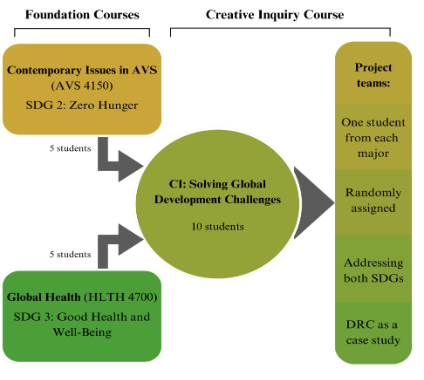
Figure 1. The two foundational courses recruited student teams to a CI called Solving Global Challenges. The competition format was created by randomly assigning two-member teams to address an SDG case study.
CI Implementation
Instructors formulated an assignment emphasizing previous course knowledge to evaluate and create a realistic solution for a pre-selected scenario in a low-income country. The Democratic Republic of the Congo (DRC) was our target country. The student teams were instructed to research the DRC, and, using the knowledge gained from their foundation courses, synthesize the challenges and opportunities related to SDGs 2 and 3. This research culminated in a final presentation of each team’s analysis of the case and proposed solutions for addressing SDGs 2 and 3 in the DRC. Instructors gave students three major points to address in their solutions: food security and human health issues in the DRC, challenges facing the DRC and the current state of those needs, and developing a strategy for mitigating food insecurity and human health issues in the country (Table 1 in Appendix). The final presentations were meant to mirror the signature assignments of both foundation courses, bringing together AVS and PHS students who had already considered how to improve the SDG situation in the countries of their choosing, and were further challenged to create a solution equally focused on both food security and health of the DRC.
The CI began with a brief explanation of the signature assignment, including intentionally vague expectations of what students should include in the final presentation to allow for intellectual freedom and ownership of their solutions. After teams were assigned in the first class, students were allowed multiple class meetings to work together on their proposals. To begin each class meeting, the instructors provided a benchmark for pairs to aim for during their meeting time. For example, the goal of the first partner-directed class session was to research the status of SDGs 2 and 3 in the DRC. These benchmarks were intended to give students an idea of how they should be progressing without strict oversight. While students were preparing their presentations for the GSC, instructors offered general support by referring them to helpful resources and answering questions not directly related to the presentation’s content.
The penultimate meeting consisted of the student teams presenting to the GSC judges. The instructors were not judges to minimize bias. The course concluded with a final meeting for GSC awards and a focus group session for students to reflect on what they gained from the course and suggest future improvements. An end-of-course survey and the focus group data were used to answer the research question about the students’ learning experience.
The three students who worked alongside instructors were recruited due to pre-existing relationships with instructors and the incentive of gaining research experience. Team engagement was maintained through positive relationships, with weekly team meetings and the early establishment of a collaborative and open-minded environment wherein instructors, students, and OTEI members alike had the ability to share their opinions and ideas with the group.
Discussion of Outcomes
Course Outcomes and Student Feedback
Students proposed thoughtful, innovative, and unique solutions to the target country’s complex problems. Each pair presented a different solution from the others, and every solution successfully incorporated both food security and human health (SDGs 2 and 3) into their ideas. The solutions were also intersectional, with many incorporating other areas of sustainable development as a piece of the puzzle. Although SDGs 2 and 3 were the two main focuses of the CI course outcomes, students included various other SDGs in their solutions. While no solution was perfect, each team thoughtfully crafted a viable solution to their understanding of the DRC’s current situation (Table 2 in Appendix). It was evident that they brought foundational course knowledge into their proposals.
The end-of-semester focus group and concluding survey allowed students to share their CI course experiences. Students reported that the interdisciplinary, team-based approach enhanced their understanding of global issues. They enjoyed the opportunity to collaborate with others in a tangentially similar but not directly related major. Students were also more confident in understanding the global challenges in their own field after explaining them to their partner from another field. They stated that they were more prepared to work toward solutions for global challenges as professionals once they graduate because of the case study approach to the course. The only change the students suggested was that the CI should be a full-semester course. The justification provided was that students would have felt less rushed, enabling even higher-quality work.
Feedback on how this unique CI course impacted student learning was very positive. All students surveyed said the course was worth their time investment and the competition style motivated them to give their best effort. Students overwhelmingly reported that the course’s flexibility was a highlight of their academic experience. Many stated they were rarely given the opportunity to perform independent research for an open-ended project in other courses. Students discussed how they felt they engaged more critically with the information they were learning when they had the opportunity to direct their own research. Additionally, instructors found that students did not ask many questions about presentation content, further demonstrating their autonomy as learners. Because the students in the CI were upperclassmen, this course gave them a chance to apply their baseline understanding of their individual fields without being asked to memorize new material or learn anything for an exam.
Some student quotes from the focus group and survey are as follows:
- “In other classes, we are often told what to do or how to approach certain topics, but in this class, we were able to do this for ourselves,”
- “We were given a real problem that didn’t have a clear solution… I liked being able to create a plan that could actually be used,” and
- “This CI was great in giving me a space to apply a lot of my knowledge.”
The concept of student ownership was never directly referenced by students in their feedback, but it is clear they felt an overwhelming sense of ownership and pride in the work they performed throughout the course. The GSC presentations were not only comprehensive but professional and polished. Students spoke about the state of the DRC and their solutions in a knowledgeable and passionate manner, demonstrating their mastery of course concepts and ability to apply their understanding of the SDGs to real-world contexts.
Reflection of Outcomes
As demonstrated in the student feedback, this learning experience was valuable for several reasons. Students met all four stages of Kolb’s Experiential Learning Cycle. First, students gained concrete experience through their foundational courses, experiencing what it might be like to put together a plan for addressing barriers to improving health or food security in a low-income country of their choosing. Students were then encouraged to reflect on and learn from their products while synthesizing their interdisciplinary solutions for this CI course, creating a plan to bring in the ideas that worked well for them in their foundational course project and alter those that didn’t work well. Finally, students were tasked with researching a country they were unfamiliar with (the DRC) and creating a new, interdisciplinary solution that integrated both members’ ideas and knowledge.
Students who participate in a positive collaborative experience gain skills in communication, conflict resolution, and adaptability2. The students raised similar points in the focus group, reporting a certain level of challenge when working with another student from a different background than their own. Still, many concluded that their communication skills grew through the experience. This growth aligns with three of the core competencies and proficiency levels outlined by Clemson’s Center for Career and Professional Development (CCPD): communication, adaptability, and collaboration.11 Developing these core competencies is pivotal in preparing students to enter the postgraduate world.
In the end-of-semester focus group, our students demonstrated a high level of competence in discussing multiple SDGs pertaining to the DRC. They talked through the interconnectedness of SDGs 2 and 3, as well as several others that pertain to infrastructure, economy, and education. This illustrates increased awareness of the SDGs as they relate to the students’ own disciplines, the disciplines of their partners, and other adjacent fields. Students who can extend their understanding of their major or discipline into other fields will likely learn more than just new material.12 This was particularly true for our students, who were challenged by the interdisciplinary aspect of the course but felt that they gained valuable critical thinking skills. They were able to create better solutions with more diverse perspectives due to their interdisciplinary approach.
A surprising takeaway from the first offering of GSC was what students found valuable about the experience. They noted their enjoyment in the research portion of the competition, which we did not expect to be a component of their positive feedback. The course objective “to increase student understanding of the SDGs and broaden students’ global perspectives through a interdisciplinary lens” was met based on presentation rubric scores. The quality and breadth of the solutions were enlightening to the research team and the course instructors.
From a research perspective, the team gained insight into how students learn and engage with the material when competing in a solution competition. The students highlighted the value of student ownership in evaluating complex situations and taking an interdisciplinary approach to present a solution, which can be a valuable pedagogical method to enhance student engagement and learning in future class offerings.
The course instructors hope to continue the GSC CI. In response to constructive feedback regarding the CI length, our team has moved the next course to the first half of the semester rather than the second half. The reason was that students have fewer academic stressors near the beginning of the semester and find it easier to focus on the project. Unfortunately, for reasons unknown to us, there was minimal student interest, and the CI was canceled. Therefore, the research team will continue to explore how to entice future students to engage in this interdisciplinary competition to see if they provide similar feedback on this course structure.
Discussion of Potential for Adoption in Other Courses
This project offers a replicable approach for instructors seeking to provide students with collaborative, interdisciplinary, project-based experience in their respective fields. While the courses were selected for their alignment with the UN Sustainable Development Goals (SDGs), the core concept – pairing two or more courses around a shared student project – can be applied across disciplines to promote both collaboration and independent inquiry.
One of the most impactful elements of this approach was providing students with the opportunity to conduct semi-independent research on a real-world problem, often for the first time. To replicate this, instructors are encouraged to design projects that balance inquiry, student autonomy, and collaboration. With structured guidance throughout the research process, students can engage deeply with challenges in their own discipline while contributing meaningfully to a broader interdisciplinary issue.
As a starting point, instructors can connect with their institution’s center for teaching and learning, such as Clemson’s Office of Teaching Effectiveness and Innovation, for support on designing interdisciplinary learning experiences and identifying potential course partners. Conversations with colleagues in related or complementary fields can help uncover natural areas of overlap; sharing learning outcomes, course topics, or assignments is a useful way to begin. From there, instructors can co-develop shared assignments or projects that align with both courses while promoting integrative, student-centered learning. Utilizing a CI course in a similar collaboration with other faculty members through an interdisciplinary approach is an ideal vehicle to increase students’ opportunities for hands-on learning.
Ultimately, this case-study based approach not only deepens disciplinary learning but also equips students with transferrable skills that employers seek, such as teamwork, communication, and problem-solving. This also supports Clemson Elevate’s strategic goal to “Deliver the #1 Student Experience in the Nation” by using interdisciplinary Creative Inquiry courses as high-impact platforms for meaningful, real-world learning.12
References Cited
- Norton, R. K., Gerber, E. R., Fontaine, P., Hohner, G., & Koman, P. D. (2018). The promise and challenge of integrating multidisciplinary and civically engaged learning. Journal of Planning Education and Research, 42(1), 102–117.
- Volkov, A., & Volkov, M. (2015). Teamwork benefits in tertiary education. Education + Training, 57(3), 262–278.
- Koeman, K. (2018). Student ownership, engagement, and the love of learning: Investigating the correlation of student ownership to student engagement (pp. 1–31) [Thesis, Dordt Digital Collections].
- Meyer, B., Haywood, N., Sachdev, D., & Faraday, S. (2008). What is independent learning and what are the benefits for students? CUREE. http://www.curee.co.uk/files/publication/%5Bsite-timestamp%5D/Whatisindependentlearningandwhatarethebenefits.pdf
- United Nations Development Programme. (2024). Sustainable development goals. https://www.undp.org/sustainable-development-goals
- World Health Organization. (2024). Sustainable development goals. https://www.who.int/europe/about-us/our-work/sustainable-development-goals
- Prior, D. D., Mysore Seshadrinath, S., Zhang, M. (Yu), & McCormack, M. (2024). Measuring sustainable development goals (SDGs) in higher education through semantic matching. Studies in Higher Education, 1–14.
- Clemson University. (n.d.). Find my experience. https://www.clemson.edu/academics/experiential-learning/find-my-experience.html
- Center for Instructional Technology and Training. (2024). Kolb’s four stages of learning. https://citt.ufl.edu/resources/the-learning-process/types-of-learners/kolbs-four-stages-of-learning/
- Kolb, A. Y., & Kolb, D. A. (2021). The Kolb experiential learning profile. Experience Based Learning Systems, LLC. https://learningfromexperience.com/downloads/research-library/kelp-2021-technical-specifications.pdf
- Center for Career and Professional Development. (2024). Grow in core competencies. Clemson University. https://career.clemson.edu/channels/grow-in-core-competencies/
- Oudenampsen, J., van de Pol, M., Blijlevens, N., & Das, E. (2023). Interdisciplinary education affects student learning: A focus group study. BMC Medical Education, 23(1).
- Clemson University. (2023, April). Clemson Elevate strategic plan. https://media.clemson.edu/ows/web/pdfs/clemson-elevate-strategic-plan.pdf
- United Nations. (2022). Sustainable Development Goal 2. https://sdgs.un.org/goals/goal2
- United Nations. (2022). Sustainable Development Goal 3. https://sdgs.un.org/goals/goal3
- Blaha, L. M., Abrams, M., Bibyk, S. A., Bonial, C., Hartzler, B. M., Hsu, C. D., Khemlani, S., et al. (2022). Understanding is a process. Frontiers in Systems Neuroscience, 16. https://doi.org/10.3389/fnsys.2022.800280
Appendix
Table 1. Global Solution Competition (GSC) Evaluation Rubric
| Criteria | Excellent (4) | Good (3) | Fair (2) | Poor (1) |
| Food security and human health issues in the DRC* [UN SDGs** Zero Hunger14 (SDG 2) and Good Health and Well-Being15 (SDG 3)] | Clearly and concisely critiques the situation in the DRC in relation to SDG’s 2 and 3, including “important intersections” between the two and other pertinent SDG’s | Demonstrates knowledge of SDG’s 2 and 3 and relationship to the situation in the DRC, should include at least a “high level understanding16 of the intersections” between the SDG’s | Identifies and describes specific SDG 2 and 3 related issues in the DRC. | Lists or states facts associated with food security and human health issues in the DRC. |
| Challenges facing the DRC in meeting food security and human health needs | Clearly and concisely critiques the challenges that the DRC faces in providing robust systems for ensuring its citizens have reliable access to adequate and quality food and health services | Demonstrates knowledge of the challenges facing the DRC in providing adequate and quality food and health services | Identifies and describes specific challenges facing the DRC in providing adequate and quality food and health services | Lists or states specific challenges facing the DRC but lacks a clear description of the listed challenges |
| Strategy for mitigating food insecurity and human health issues in the DRC | Generates and clearly and concisely communicates a well-structured strategy relying primarily on locally available resources (when possible) for addressing food security, human health, and related issues in the DRC | Strategy presented adequately gauges the factors affecting the why of the situation, but the solution presented lacks clarity and is limited in utilization of locally available resources | Strategy clearly describes the overall needs but provides no clear path toward solving the underlying drivers of food insecurity and inadequate human health care in the DRC | Strategy, as presented, states the drivers leading to food security or human health issues but the solution(s) provided are not realistic given available resources and infrastructure and/or is not linked to the drivers |
*DRC = Democratic Republic of the Congo
**SDG = Sustainable Development Goal
Table 2. GSC Student Presentation Topics and Descriptions
| Group | Solution | Description |
| 1 | Hydroponics | Growing healthy, high-yield crops faster, cheaper, and in a less resource-draining way to improve food security and decrease malnutrition rates. |
| 2 | Improving Education | Educating citizens of the DRC to improve crop resiliency/production, utilize natural resources, increase distribution of home-grown food, decrease the spread of contagious disease, and improve health literacy. |
| 3 | Water/River Transportation | The DRC’s waterways are used to increase access to healthcare and natural resources, create job opportunities, and grow the economy through trade and tourism. |
| 4 | Road Transportation | Improving the DRC’s road infrastructure to 1. facilitate transportation of agricultural goods and 2. allow mobile health units to reach communities without access to healthcare. |
| 5 | Non-Governmental Organizations | Facilitating relationships with non-governmental organizations to secure funding and resources to improve sustainable agriculture, increase food security, decrease communicable disease, and improve maternal and neonatal health. |